Standard One SH scores every option in one pass
Open-weight decision models that return a probability for every option in one forward pass: 51.5 and 57.4 on the Decision Index 0.3 public index, self-scored with the official kit, with the detail and the limits.
Standard One SH is a pair of open-weight decision models, Standard One 8B SH and 3B SH, served through the Standard One API. You send a situation and questions with options you define; the model reads the request once and returns a probability for every option, without generating text.
Your code sets a bar: it acts when an option’s probability is above it and hands the case to a person otherwise. That suits calls a product makes all day, such as routing a ticket or filtering phishing.
The 3B has the highest public index under 4B parameters
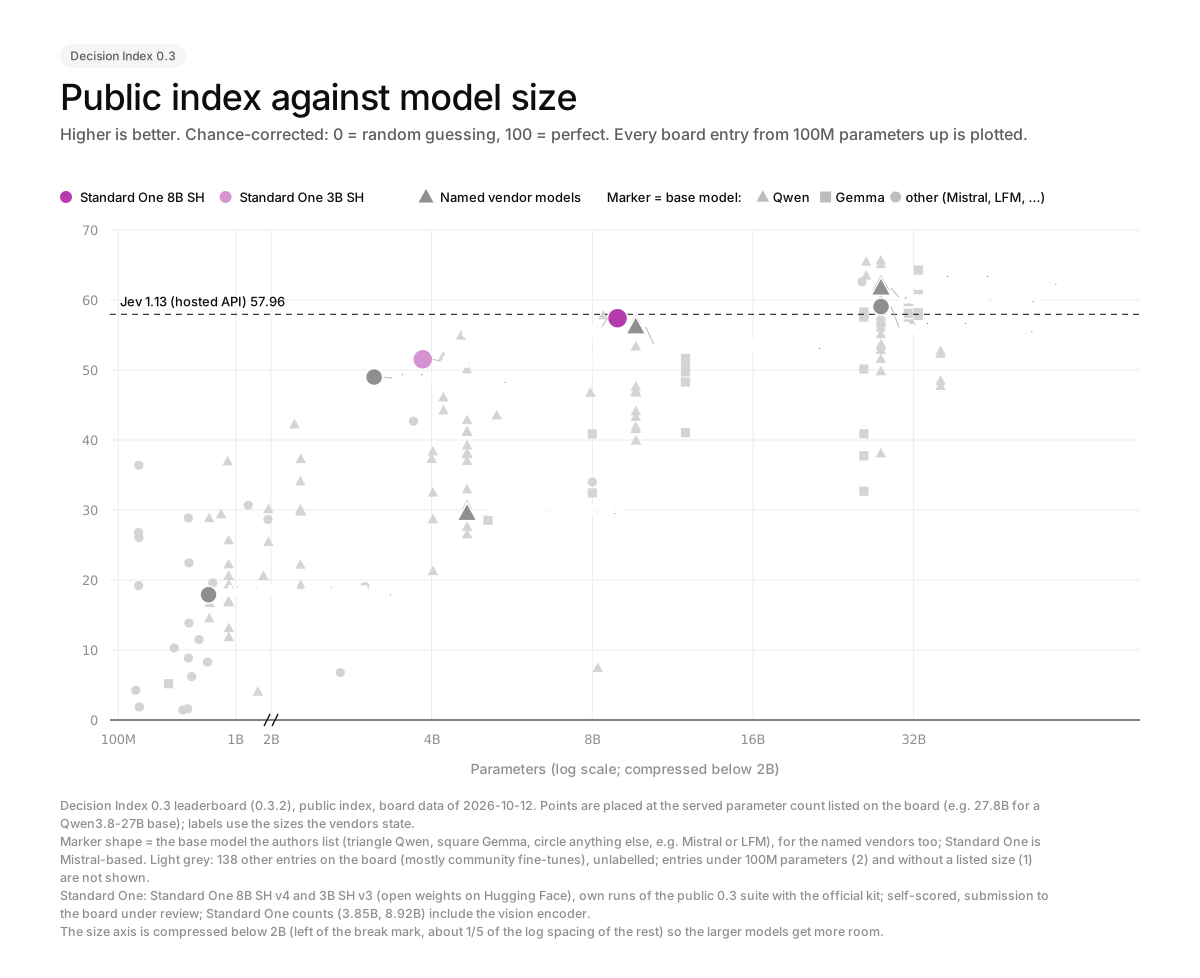
Unless a section says otherwise, every score is the Decision Index 0.3 public index, self-scored by us with the official kit. Scores for other models are the board data of October 12, 2026; Jev 1.13 is a hosted API and the usual reference. The models were trained on our own synthetic data and on public training data; no benchmark test items were used. Each figure’s note names the public training data that applies to it.
The 3B SH scores 51.53, the highest of any model under 4B parameters (next: Liquid AI d1‑3B, 48.99). The 8B SH scores 57.40, above Cloudflare clef‑flash 9B (56.15) and below Jev 1.13 (57.96), two community entries of about 8.4B and 9B (57.8 and 58.1) and the 27B-class vendor models.
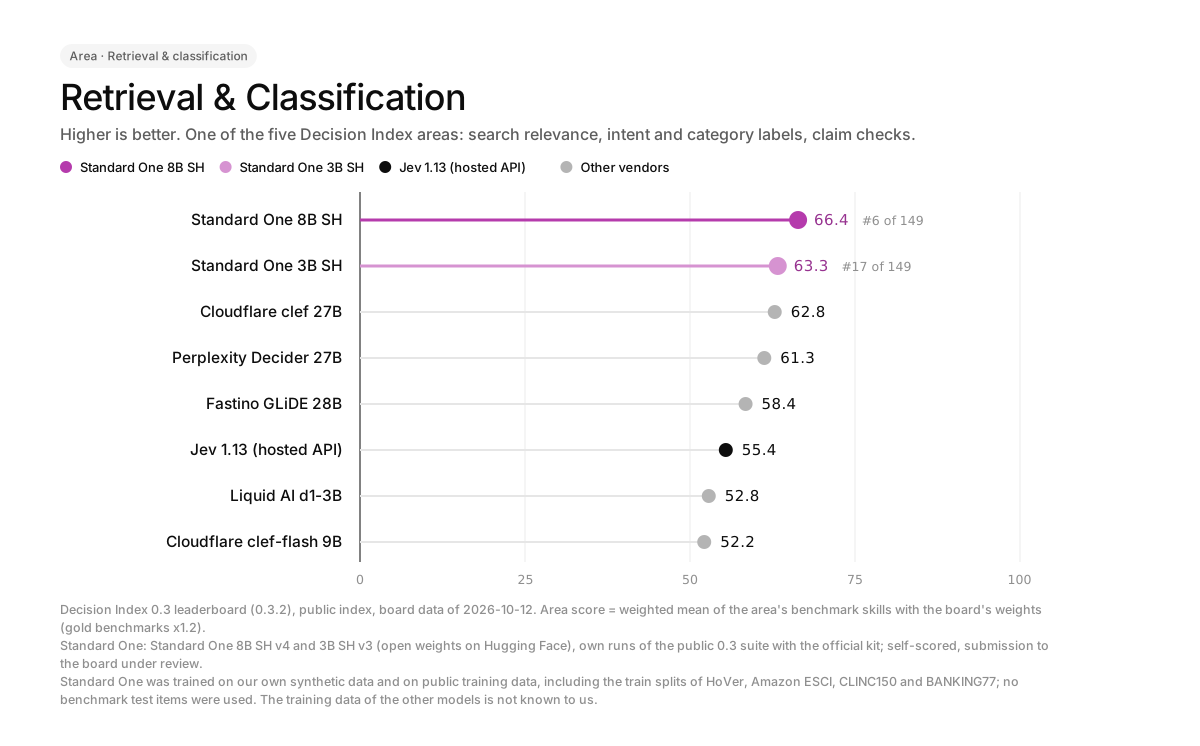
In Retrieval & Classification the 8B scores 66.4 (#6 of 149) and the 3B 63.3 (#17), both above every vendor model shown (next: Cloudflare clef 27B, 62.8). The 8B is 11.0 points over Jev 1.13 (55.4).
In Tools & Automation the 8B scores 84.0 (#5), first among the vendors shown (next: Fastino GLiDE 28B, 83.6) and 8.9 points over Jev 1.13 (75.1). The 3B scores 79.8 (#12), below three of those vendors.
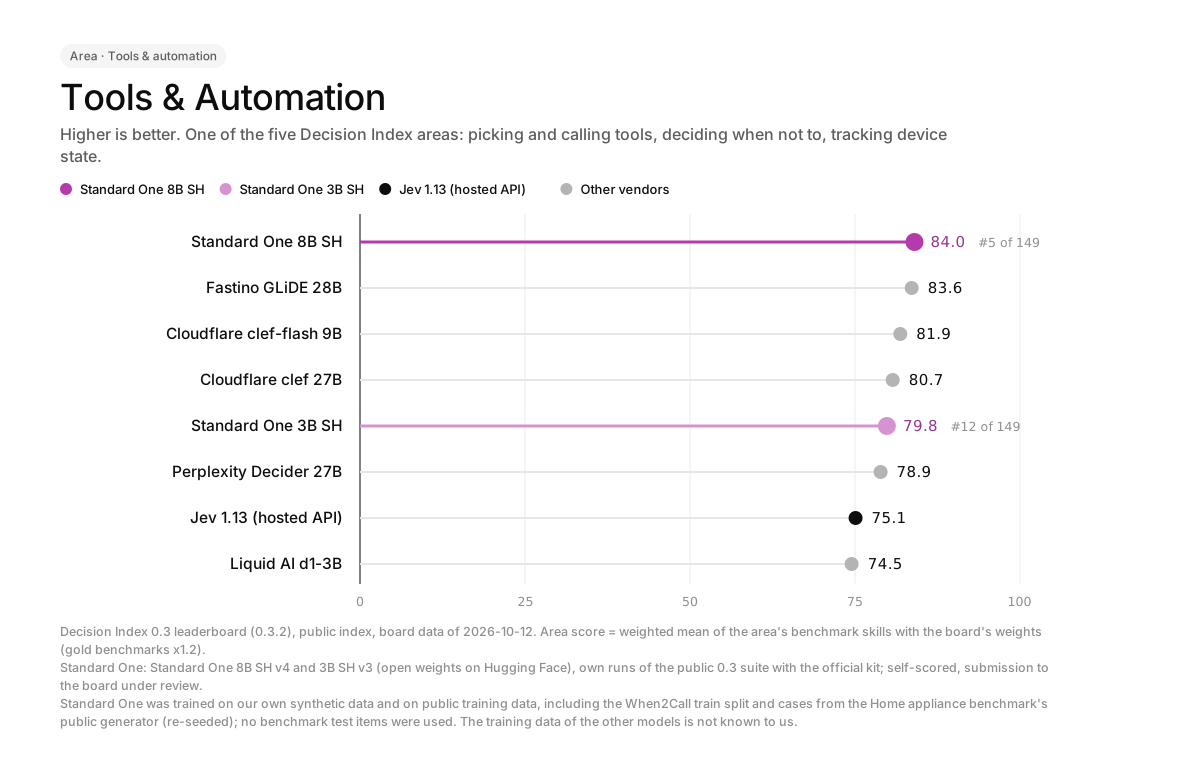
A rank such as “#6 of 149” places one Standard One model alone on the board’s 148 entries; other entries are above the 8B in both areas.
SH adds a joint schema head to the Standard One backbones
SH stands for joint schema head: it scores every option of every question in the same forward pass that reads the scenario.
The 8B SH puts a 70.6M-parameter head on the Standard One 8B v2.2 backbone (Ministral 3 8B text with a Pixtral vision tower), and the 3B SH does the same on 3B v2.2; the counts 8.92B and 3.85B include the vision encoder. Both are open weights under Apache-2.0, dated October 13, 2026: StandardOne-8B-SH and StandardOne-3B-SH.
Both trained further, mostly on our own synthetic decision items: the 8B SH from 48.34 (v3) to 57.40 (v4), the 3B SH from 42.90 (v2) to 51.53 (v3), public index.
The public index covers about 140,000 requests in five areas
The Decision Index 0.3 has about 140,000 requests from 37 scored benchmarks in five areas: Knowledge & Reasoning, Language Understanding, Retrieval & Classification, Tools & Automation and Arts & Human Taste. We ran the official kit on all 140,178 scoreable requests; our runs are in a Hugging Face dataset. Scores are chance-corrected (0 is random guessing, 100 is perfect), not accuracy. The public index is 20% of the board’s Full score and private tests make up the rest, so none of these numbers is a Full score.
Five public index benchmarks show the detail behind the areas
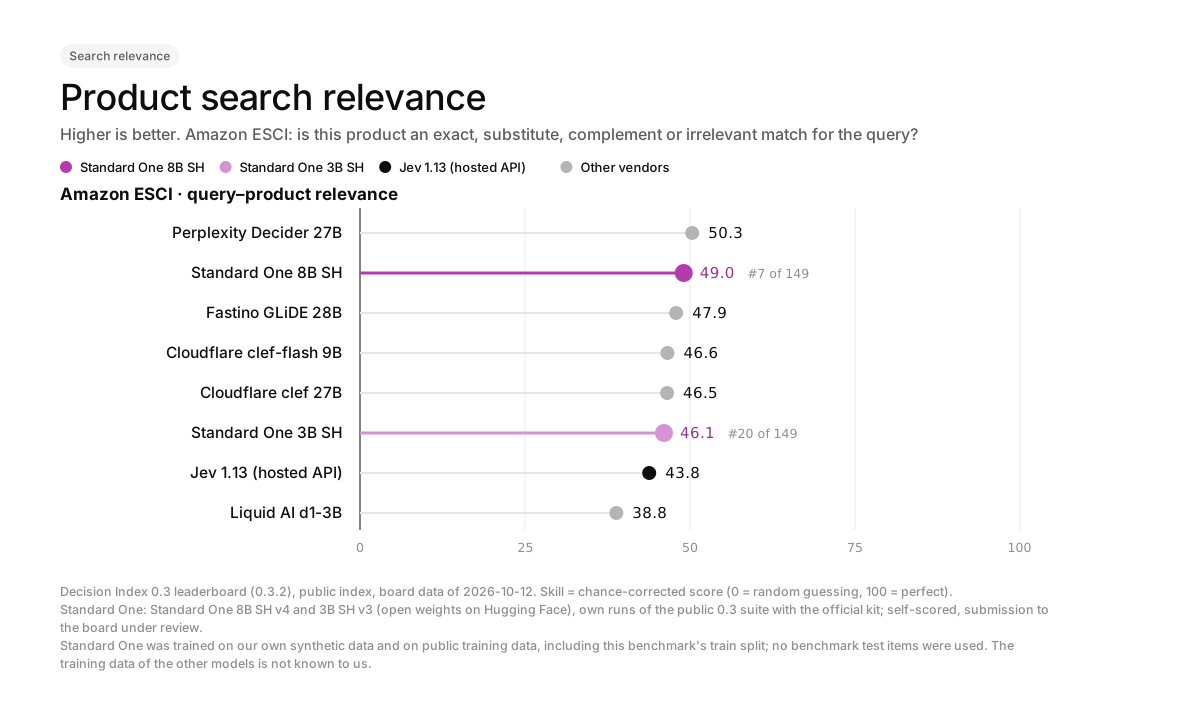
Amazon ESCI. Product search relevance. The board’s metric is macro-F1, and the chart shows the chance-corrected skill score based on it. The 8B scores 49.0, second to Perplexity Decider 27B (50.3) and ahead of Jev 1.13 (43.8); the 3B scores 46.1. Its public train split was part of the training data; no test items were used.
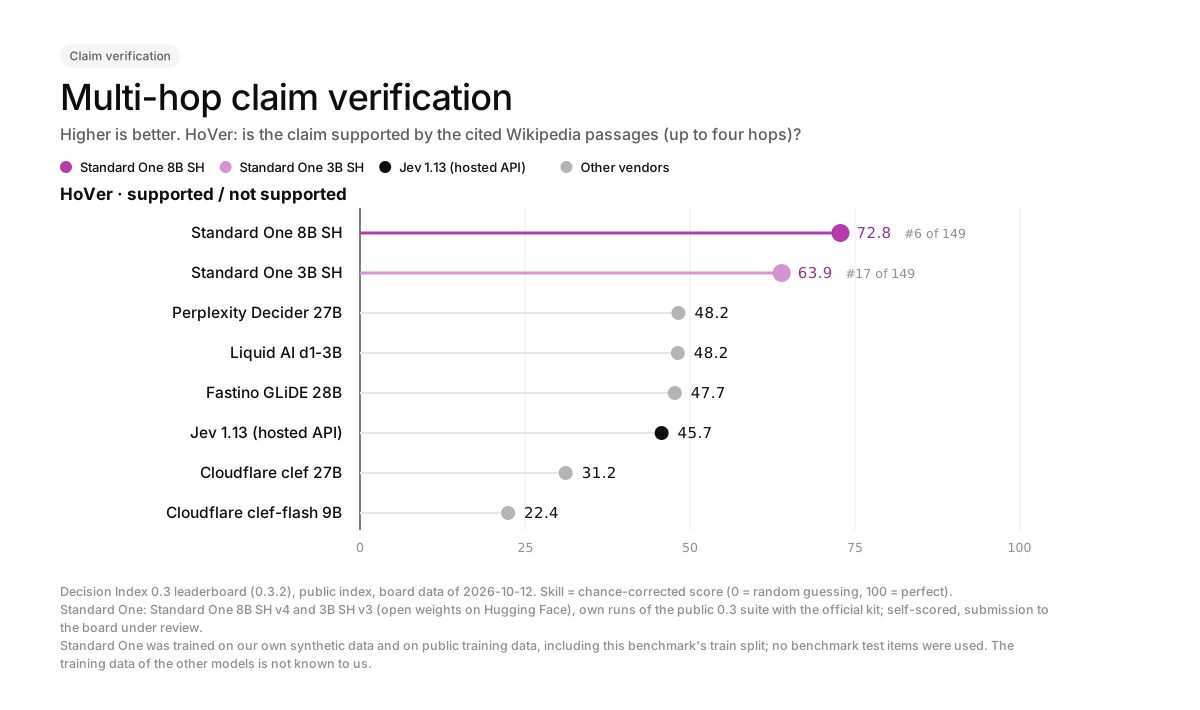
HoVer. Is a claim supported by the cited Wikipedia passages? The 8B scores 72.8 and the 3B 63.9; the best vendor model shown scores 48.2. Its public train split was part of the training data; no test items were used.
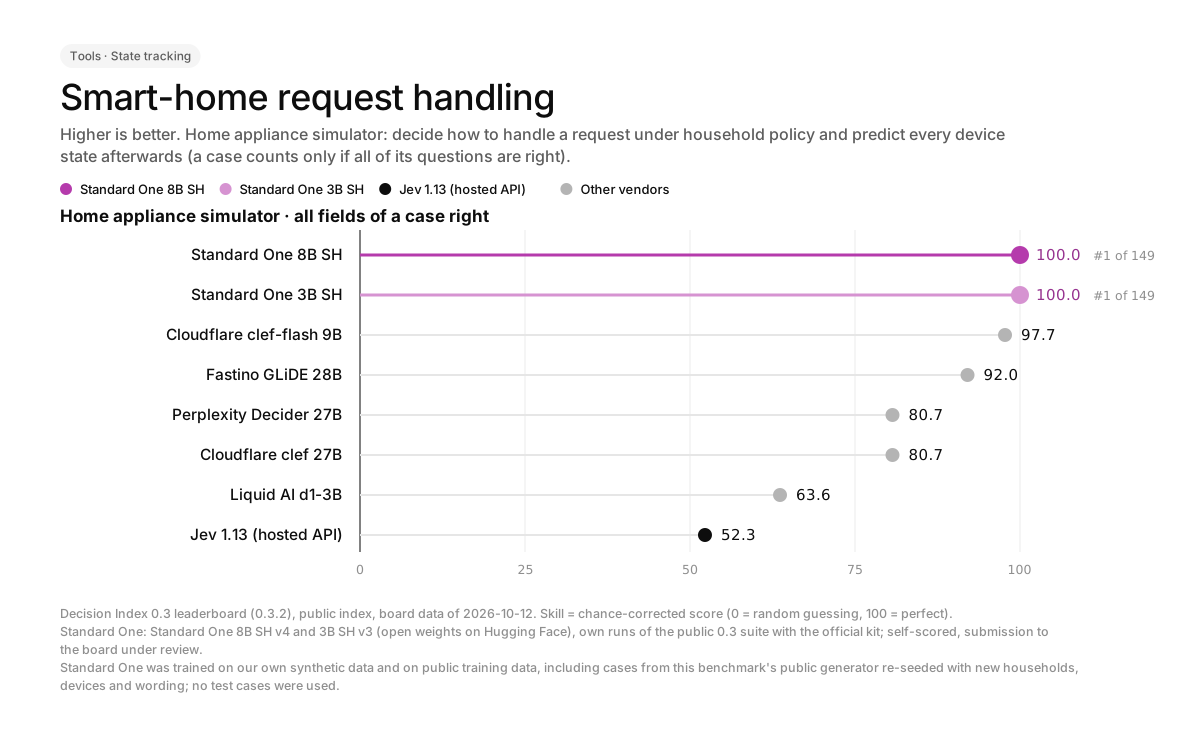
Home appliance simulator. The model handles a request under household rules and predicts every device’s state; a case counts only if all answers are right. Both models score 100, the top of the whole board, tied with two other entries above 25B; the best vendor model shown scores 97.7. Cases from its public generator, re-seeded with new households, devices and wording, were part of the training data; no test cases were used.
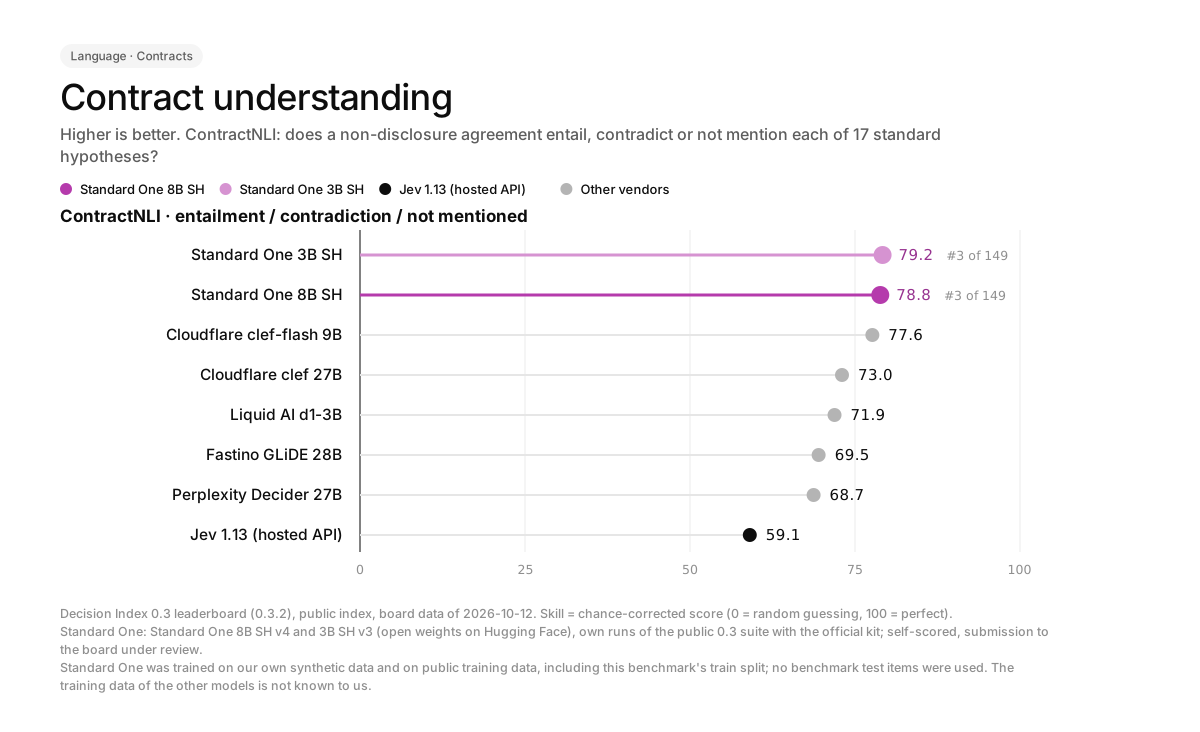
ContractNLI. Does a non-disclosure agreement entail, contradict or not mention 17 standard clauses? The 3B scores 79.2 and the 8B 78.8, first and second among the vendor models shown. Its public train split was part of the training data; no test items were used.
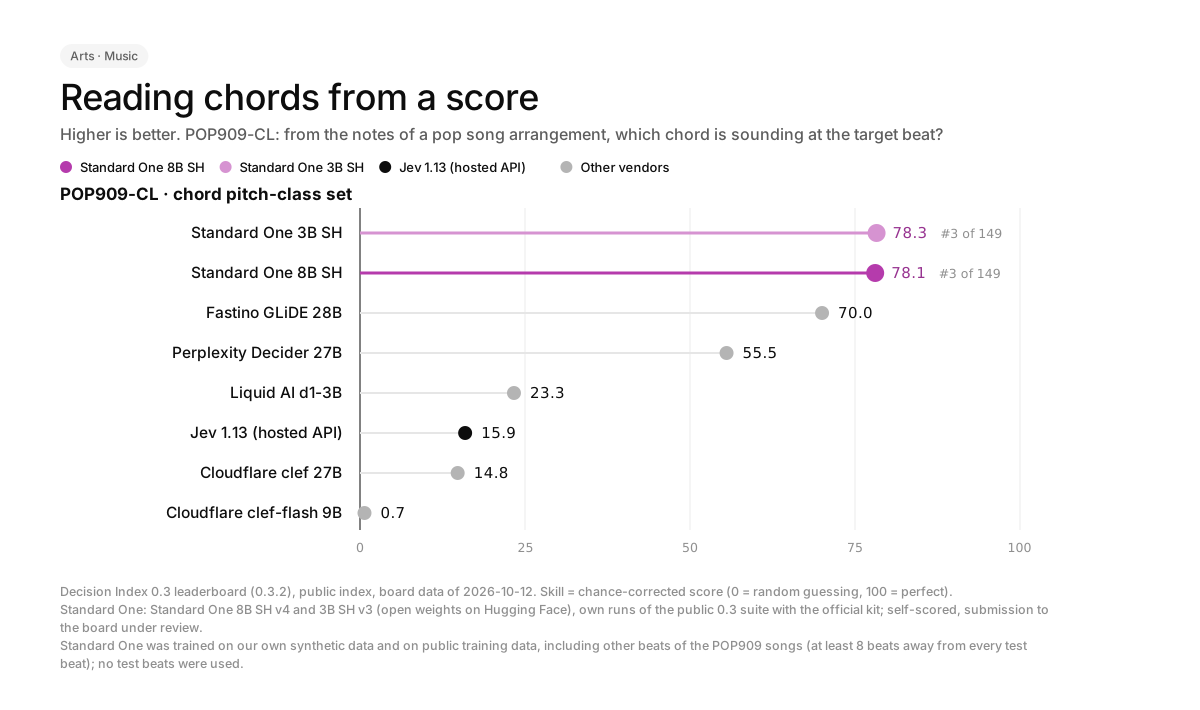
POP909‑CL. From the notes of a pop-song arrangement, which chord sounds at a given beat? The 3B scores 78.3 and the 8B 78.1; the best vendor model shown, Fastino GLiDE 28B, scores 70.0. Other beats of the POP909 songs, at least 8 beats from every test beat, were part of the training data; no test beats were used.
A small 21-language test is a secondary result
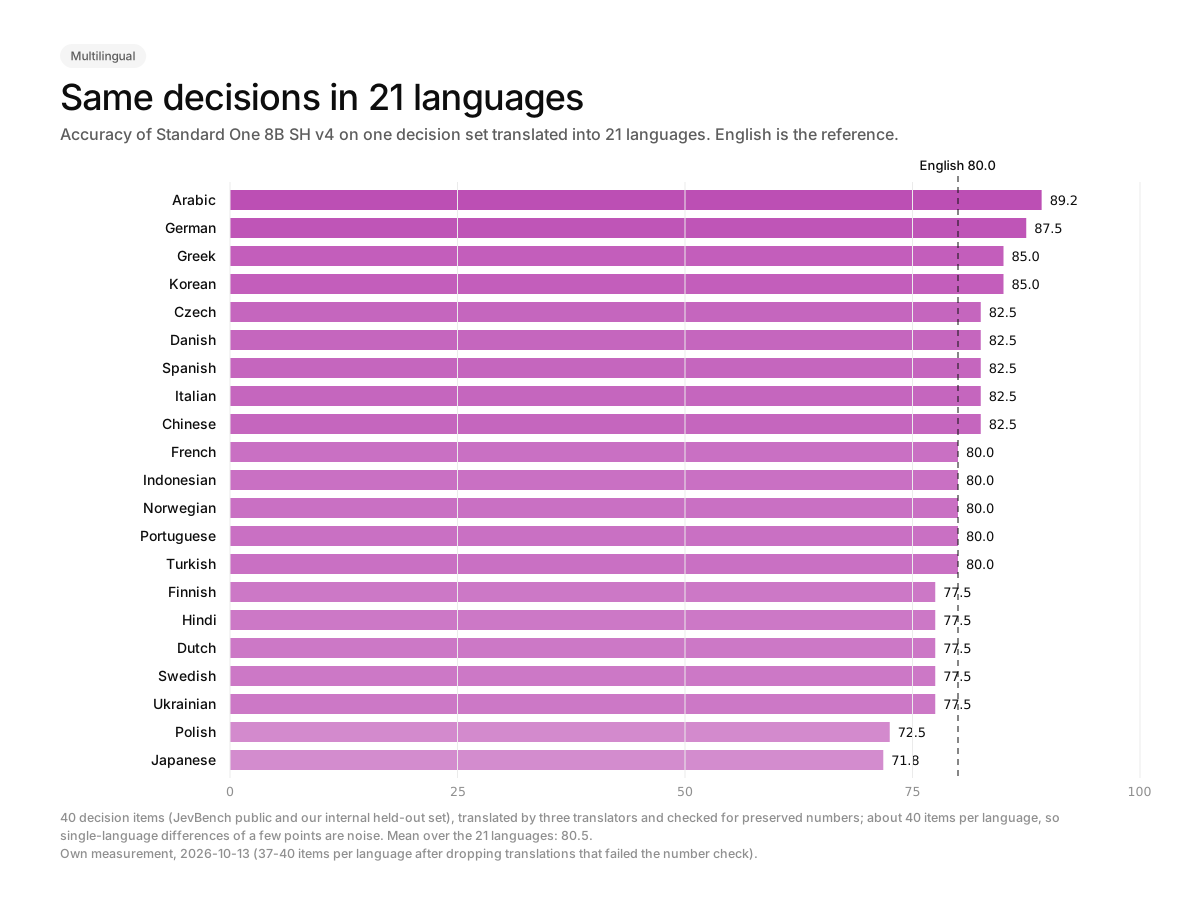
Our own measurement of the 8B SH v4, outside the public index: about 40 decision items (JevBench public and our internal held-out set) translated into 21 languages by three translators and checked for preserved numbers. The mean is 80.5 against 80.0 in English, from 89.2 in Arabic to 71.8 in Japanese. With 37 to 40 items per language, a few points are noise. These are accuracy figures, not chance-corrected.
Read these limits before you compare
Not an official ranking. The board has not listed our submission, which is under review.
Training data. The models were trained on our own synthetic data and on public training data (the train splits of HoVer, Amazon ESCI, ContractNLI, POP909‑CL, CLINC150, BANKING77 and When2Call, and the Home appliance generator). No benchmark test items were used. We do not know the other models’ training data.
Where we do not lead. On the public index the 8B scores 36.9 in Knowledge & Reasoning and 57.9 in Language Understanding, against 53.9 and 59.2 for Jev 1.13. Cloudflare clef 27B is ahead on both intent benchmarks (CLINC150: 97.4 against 94.6 for the 8B), though we trained on both train splits, and on phishing emails; Perplexity Decider 27B is ahead on sarcasm.
Model cards. The 8B card’s main table compares SH v3 and v4. Its 600-item hard held-out suite has accuracy figures for SH v2 (46.00) and v3 (41.17) only, against 53.50 for Standard One 8B v2.2, with no v4 figure; the card advises the non-SH model there. The 3B card gives 41.67 for SH v2 against 44.67 for 3B v2.2 on it.
Inputs. The cards say “Text input only has been validated for this release.” That is a statement about validation scope. Requests longer than 32,768 tokens are refused, not truncated. Probabilities are calibrated on our held-out data, so refit thresholds on yours, as the LLM confidence threshold guide explains.
Try the API, read the docs or take the weights
The Standard One API serves the SH models, and you start with free credit on the Standard One page. The docs describe the request and response; their evaluation section still reports the earlier v2.2 measurement, in accuracy, until we re-run it on SH. The same weights are on Hugging Face as 8B SH and 3B SH, each with a reference server.
Sources and verification
Sources used for this resource. Verification dates describe our source checks, not provider effective dates.
Standard Thinking organization on Hugging Face
Lists the StandardOne-8B-SH and StandardOne-3B-SH repositories and the StandardOne-SH-decision-index dataset as updated on the day of checking.
Standard One 8B SH model card (v4)
Defines the joint schema head, the v2.2 backbone and 70.6M-parameter head, the main table for SH v3 and v4 (public index 48.34 and 57.40), the hard held-out suite figures for SH v2 and v3 against Standard One 8B v2.2, and the text-validation and 32,768-token limits.
Standard One 3B SH model card (v3)
Defines the 3B SH on the v2.2 backbone, the v2 (42.90) and v3 (51.53) public index scores, the hard held-out comparison of SH v2 with 3B v2.2, and the text-validation and 32,768-token limits.
Standard One SH Decision Index runs (dataset)
Lists self-scored runs of the public 0.3 suite for 3B v2 (42.90), 8B v3 (48.34), 3B v3 (51.53) and 8B v4 (57.40), with the requests and responses as the kit wrote them.
Offers free credit to start and still describes One 3B and One 8B, so the post states no amount and no SH detail from it.
Standard One documentation, Evaluation
Reports One 3B and One 8B accuracy on 600 realistic decisions measured on v2.2 weights, an earlier measurement that the post does not set beside the public index.
Continue exploring
2.6%95% upper bound for 3 errors in 300
- Observed
- 1.0%
- Threshold
- Fixed before validation
- Sample
- Independent validation
One-sided Clopper–Pearson bound, not a worst-case guarantee
How to set an LLM confidence threshold
Select a candidate threshold, freeze the policy and validate accepted-answer risk independently, with runnable code and sample-size limits.
3classification approaches
- Encoder
- Train on task labels
- LLM prompt
- Describe labels
- Decision model
- Score supplied options
Evaluate each on the same held-out workload
Fine-tuned classifier vs LLM: how to choose
Choose an encoder, prompted LLM or decision model by your data and labels; research and historical Standard One results use different measurement conditions.
TPMa rate with provider-specific rules
- Capacity
- PTU · MU · GSU
- Billing
- Units · GPU-hours
- Limits
- Windows · concurrency
Definitions before price comparisons
LLM capacity and plan terms defined
Definitions for inference capacity units, billing terms, workload estimates, and subscription limits, with provider-specific meanings kept explicit.